I. Introduction: Digital Crossroads or Digital Cliff?
The consolidation of citizen PII (personally identifiable information) by the federal government is a topic I've been following for a while now, and there have been a few notable developments in 2025 since the Trump administration began implementing policies. Today I'm looking at a few events that have been reported on that detail how driver-license data, law-enforcement data networks, and AI-assisted license plate-reader surveillance are being combined.
In a November 12th article, Reuters reported that several Democratic lawmakers addressed state governors urging them to close a digital loophole that is allowing federal immigration agencies to access their states' resident PII. This is occurring via a data-sharing system run by a nonprofit organization known as Nlets. [1]
In a November 20th article, AP News reported that the U.S. Border Patrol (BP) is running a nationwide monitoring program using license-plate readers and algorithmic "pattern of life" analysis. Drivers may be flagged for suspicious behavior or patterns, and citizens have been pulled over, or even detained after being pulled over under other pretexts. [2]
Federal actions such as these are the building blocks of a comprehensive citizen registry. Imagine a database with every digital detail about a citizen. Your driver's license, social security number, and voter status. You might think that doesn't sound ominous, but at the moment, states and the federal government don't have a shared database of all of that info. Now consider other digital components of your identity. Add in your state records for VINs, driving history, concealed weapons permit, and voting affiliation. With driving patterns being tracked, credit scores may not be far behind. For now, much of this is being justified for immigration enforcement, but it raises questions about civil liberties.
II-a. State DMV data and Federal Access Through Nlets
DMVs across the country (including all 50 US states, Washington, D.C., and U.S. territories) feed driver license and vehicle registration data into the Nlets system, which in turn make records accessible to law enforcement agencies in the US and Canada. These number approximately 18,000 between federal, state, local, tribal and territorial agencies. [3]
ICE and Homeland Security Investigations (part of the Department of Homeland Security) are two of the federal agencies that also make use of the Nlets system, and together have accounted for close to 900,000 database queries as of October 1 of this year. Many states are unaware of how much of their data is being shared with federal immigration agencies via the Nlets system. [1]
As of November 12th, some states had blocked ICE and Homeland Security Investigation's access to state-driver data, but many states remain unaware that data was being shared, or where it was going. Senator Ron Wyden, and 39 other Democratic lawmakers penned a batch of letters requesting several state governors to block access to residents' data. At the time of writing, only New York, Illinois, Massachusetts, and Minnesota had blocked ICE from accessing records through Nlets. [1] [2]
Nlets, originally known as The Law Enforcement Telecommunications System (LETS), is a nonprofit organization, that was established in 1967. In 1970 the organization was incorporated in Delaware as a nonprofit as NLETS, Inc. (the National Law Enforcement Telecommunications System). In 2010 the organization changed its name to The International Justice & Public Safety Network, but retained use of the Nlets acronym.
The Nlets systems allow the sharing of information covering a variety of requests. Request types include, but are not limited to driver history, drivers license, vehicle registration, concealed weapons, and wildlife violations data. Data availability varies by type and location, but may be requested from US states, Canada, the US DOJ, the US Armed Forces, Passport Services, Postal Service, TSA, and so on. You can view a list of organizations and municipalities they can send data notifications to, as well as the types of queries that can be run, here. It is quite extensive.
II. How We Got Here: The Architecture of a Nationwide Citizen Database
II-b. License Plate Readers and Predictive Surveillance Networks
In its November 20th report, AP News described how the US Border Patrol uses its predictive surveillance with a growing network of cameras that extends beyond border states. These cameras are often hidden, and the images are scanned for license plate information. Algorithms evaluate patterns such as unusual routes, repeated trips, or travel at unusual times. [2]
Once identified, federal agencies may enlist local law enforcement to find a pretext to pull a suspect over. The person might be pulled over for something unrelated or innocuous such as speeding or, as CBS News reported, "even a dangling air freshener blocking the view." Once pulled over, the person might be questioned and searched, with no explanation, and they may never realize that law enforcement was monitoring them for something as minor as traveling past a specific camera. [4] [5] [6]
II-c. Potential Data Fusion with Citizenship & Voting Records
As states consider merging or integrating driver license data with federal immigration and/or citizenship data, the infrastructure could easily extend into into voting eligibility and affiliation databases. The Department of Justice has expressed interest in having a system with combined identity and citizenship status in order to centralize eligibility checks for voter fraud enforcement.
III. Making the Case for Integration
Advocates of a consolidated records system tout their uses for achieving public safety goals. Vehicle tracking alongside predictive programs could help to detect drug trafficking, human trafficking, or organized criminal networks operating across borders or state lines. Some patterns that may not be apparent within a jurisdiction may be more evident at a larger scale.
A centralized system that integrated identity systems could streamline the processes and remove some of the redundancies for people moving from one state to another, or for recovering and replacing lost documentation. Particularly for non-citizens, it could improve the immigration, citizenship and travel experience for people coming into the country; and some of these benefits would also apply to natural citizens. A unified dataset could support emergency response, missing person cases, and cross-jurisdictional investigations, ensuring consistent information across agencies.
Centralization also brings efficiency: fewer siloed systems to maintain, more standardized data formats, and potentially reduced operating costs.
Some potential benefits, such as disaster response, missing-person recovery, or improvements to the “immigration and travel experience”, are plausible but tangential to the core argument. These could fit more naturally in a separate essay focused on “positive use cases” rather than surveillance-risk analysis.
Relevant citation:
ACLU’s “You Are Being Tracked” report notes that while ALPR data can assist with Amber Alerts and car-theft recovery, these represent a small fraction of actual ALPR usage.
Some emerging developments, such as ICE’s deployment of facial-recognition apps, mobile iris-scanning tools, and phone-based spyware, represent a widening technical scope that goes beyond DMV and ALPR data. While relevant to the broader landscape of federal surveillance, these technologies operate through different pipelines and legal frameworks. They may be better explored in a follow-up essay focused on biometric identification and device intrusion rather than mobility-tracking infrastructure.
Relevant citation:
NPR’s November 8, 2025 reporting documents ICE’s experimentation with on-device facial recognition and surveillance software capable of extracting data from encrypted phones.
Notably, the benefits described above rely on trust, oversight, and strict limits. These are often absent in rapidly expanding surveillance systems, and in the current space, many of the oversight agencies have been either handcuffed or outright eliminated already.
What began as a limited smuggling monitoring operation in border states, has quietly become a nationwide surveillance system that tracks everyday drivers. Although described as targeting illegal activity and immigration, it also normalizes surveillance of lawful behavior. With cameras and other surveillance tools being hidden in discrete objects like traffic cones, drums, and barrels, citizens are unlikely to know when and where they are being monitored. AP News reports that Border Patrol has had access to at least 1,600 license plate readers in 22 states, and data from Flock Safety, Rekor, and Vigilant Solutions. [2] [5] [6]
Alongside this physical infrastructure, a new category of "algorithmic suspicion” is becoming a new form of probable cause. People are detained not because they broke a law, but because their movement resembles a pattern an algorithm has decided is concerning. Minor infractions serve as convenient pretexts, obscuring the true trigger, and bypassing due process. Even small ALPR inaccuracies can turn into major incidents. Misreads are commonplace, and false positives have led to wrongful detentions and armed stops in several states, as documented by civil liberties groups. [2] [5] [6]
The consolidation of driver license data, citizenship information, and voter registration records also creates opportunities for selective targeting of specific communities. This raises the risk of politically motivated investigations, discriminatory enforcement, or manipulation of public services. Marginalized communities, including immigrants, racial minorities, and economically vulnerable populations, are historically the most exposed to such practices. Recent events such as racially motivated gerrymandering, deployments of federal forces to politically opposed states, and threats of punitive funding cuts illustrate how easily data can be misused for political advantage.
Another concern is the permanence of the infrastructure itself. Even if expansion stopped tomorrow, the existing systems would continue to operate, and agencies would still have access to accumulated data. Dismantling these systems would require dedicated funding and political will, while future administrations could repurpose or expand their use in ways never originally intended. NPR recently reported on a whistleblower complaint alleging that Social Security and related personal data were copied to a private cloud environment with insufficient safeguards, potentially exposing the records of more than 300 million Americans. [7]
Compounding these risks is the lack of transparency surrounding how data is shared and accessed. Many states do not have a full picture of how their residents’ information moves through the Nlets network, or which federal agencies are making queries. Some law-enforcement agencies maintain contracts with private surveillance vendors under nondisclosure agreements that block public oversight. With covert placement of license plate readers and little mandated reporting, the public has few ways to know what is being collected, how it is being used, or how to challenge improper surveillance.
V. Citizen Action: What People Can Do
A large part of the danger of the systems being described here is that much of the work is happening quietly, and becomes an almost imperceptible part of our everyday lives. We sacrifice privacy for convenience, and freedoms for safety. Often these sacrifices are made by marking a checkbox signifying acceptance of a service agreement, without actually reading the agreement.
The good news though is that once people are paying attention, asking questions, and demanding accountability, that can force legislators to enact change. It's not always easy, but it takes numbers, and it takes persistence.
Understand how your state's data moves Start with the basics: does your state share its DMV and registration data through Nlets? If so, has your state enacted any blocking measures to prevent federal agencies from accessing it, and are there any justifications that federal agencies can use to bypass those measures? In many states, lawmakers were unaware that federal law enforcement agencies were accessing state data. Reuters, AP News, FedScoop, and other media sources can help you stay apprised of any updates.
Following license plate reader news and surveillance news is equally important. Most people don't realize that these systems are operating away from the border, or that their driving patterns may be monitored and analyzed.
Press state and local officials to draw boundaries State government often have more authority than they often make use of. You can ask questions of your state representatives and officers. For example:
Has the state blocked federal access to driver and registration data through Nlets, and if not, why?
How many queries do ICE, HSI, or BP make each year? How many queries have they made this year?
Is their any oversight or audit process in place for how data is being requested or used?
Audits are standard in many industries, and oversight is not optional for most forms of data that interact with PII. Requiring public disclosure of query volumes, justification categories, and retention timelines is a basic safeguard. Supporting legislation that demands warrants for pattern-based surveillance, or institutes automatic data deletion helps to ensure agencies justify their tools instead of treating them as default.
Build awareness at the community level Community and civil rights groups can help in multiple ways. Civil rights groups are often knowledgeable, while larger groups can inspire a strength-in-numbers confidence. Groups can organize public pressure campaigns, write petitions, and draft form letters to address lawmakers. Many civil rights groups and nonprofits also know of the legal steps to navigate and can help direct the community.
Demand enforceable guardrails No one wants to live in a police state. The public can insist on something simple: surveillance should be done when there is probable cause, and should not become the norm.
algorithms should not replace probable cause
voters need to have say before enabling nationwide surveillance
there needs to be visibility on how data is being collected and used
there needs to be oversight and independent audits that publish hard numbers to ensure that rights are not being abused, and our data is not being misused
None of this fixes the system overnight, but each step makes it harder for authorities to operate in the dark.
VIII. Conclusion
I tried to stay as objective as I could throughout, but I know there are times that I was unable to do so. In all honesty, much of this stuff I find to be terrifying. A lot of this data already exists at some government level, but most of it is not consolidated. Frequently the republican platform at least says that the federal government needs to allow states to govern. Nationwide databases and surveillance is very much in opposition to this, and in that view is very hard to justify.
Some of the cited references are good starting points for doing your own research on the above topics, and a few other key words worth watching for are 'biometrics', 'privacy', 'surveillance'.
I will try to update this post with additional resources at a later date, along with some info on form letters you can use to write to lawmakers to address concerns.
As a disclaimer for this post, I want to make a note that I'm not intending to judge anyone for their spending choices. I wanted to provide some information for people interested in avoiding spending money with megacorporations. One of the people referenced in this post is fond of saying that everyone is at a different place in their journey when they want to make a change.
Some people want to make more of a change than they are able, but are limited by circumstances. If you fall into that situation, there's no reason to feel guilty about that. I wish I could avoid buying anything packaged in plastic, and many other similar choices, but that's a lot harder to do than you might think. Additionally, I'm not looking to tell anyone how they can or cannot spend their money. Some things that are wasteful, are surprisingly less wasteful than things you would expect to be more eco-friendly. There's a lot of research needed to be fully aware of making all the "right" decisions, and it's not right to place that responsibility on the average consumer.
And, with that...
I've mentioned a few times lately that I'm trying to steer away from large corporations, most specifically Amazon, Google, and Microsoft. A lot of that is data privacy-related, but trying to stop giving money to mega-corporations is also a big factor. I spend enough time tallking about the reasons, and I'll continue to do so in the coming weeks, but that's not what I was planning to write about tonight. Most of the things I've had something to talk about have been divisive topics, and at least in my case, come from a place of anger. That is partly at the root of the topic, but not really at the heart of it.
With tomorrow being black friday, and with a lot of the people I follow across social media being involved in a push for a nationwide weeklong blackout, I felt like putting together some info for people that wanted to look for some alternatives or learn more about the reasons behind it. Some of the people I follow can do a much better job talking about it, so I've linked a couple of them below. The Woke Ginger and Cut Off the Spigot are a couple people I found on instagram that share alternatives to large corporation spending, primarily small businesses. The Woke Ginger also does analyses on business political leanings and donation histories. This can be helpful for people interested in "voting with their wallets."
I included links for a couple of online marketplaces that I heard about a few weeks ago. I haven't had a chance to look at them since hearing about them (I haven't done any shopping at all throughout the month of November). Both of these sites are mentioned in the Holiday Guide linked under the Woke Ginger below. Both of these marketplaces are made up of primarily underprivileges groups, with minorities, women and lgbtq owners being listed as the primary store owners on the platform.
On the left-hand side below, you can navigate to the instagram site for the Woke Ginger or Cut Off the Spigot, or the marketplace for ShopRedBag and littlebluecart by clicking on any of the text or graphic in the box. On the right hand side, the social media icons will take you to the relevant social media page, and I've added a little blurb of info from each of their pages.
A vlogger that posts videos and resources for alternatives to large corporations, as well as breakdowns of political donations of different coprporations so consumers can base purchase decisions on the company's values.
Social media presence on at least Facebook, Instagram, TokTok, YouTube, and Bluesky.
Latest post on Instagram is "a curated collection of small businesses and startups that don't just sell great products, but stand firmly behind their values."
A vlogger that posts numerous videos with alternatives to large corporations for shopping needs and gifts, streaming alternatives, etc.
Social media presence on at least Instagram, TikTok, YouTube, and Bluesky, and also has a substack with several articles and resources. Is very open-minded about making small steps and is not at all preachy.
An online marketplace where consumers can shop Black-owned, Woman-owned, Veteran-owned, LGBTQ-owned, and Disability-owned stores.
"why did we make shopredbag?
In response to major retailers rolling back DEI initiatives and the resulting consumer activism, we built shopredbag to empower and elevate the brands and founders people truly believe in. "
An online marketplace where consumers can shop Woman-owned, BIPOC-owned, queer-owned, military spouse or veteran-led stores.
"About LBC Little Blue Cart began with a single, honest moment. Kate recommended a local photographer, and Erin asked, “But who did she vote for?” That question changed everything. It sparked the realization that our purchases—every single one—carry power. After the 2024 election, we turned that idea turned into action and build Little Blue Cart around a kitchen table. Our goal is simple: make it easy to support businesses that share our values of democracy, equality, and freedom. "
An online marketplace where consumers can support business that do not donate to Trump or any parts of the MAGA movement. "The goal of this collective of like-minded businesses is threefold:
We want to enable customers nationwide to purchase all of their goods in a marketplace where they know NONE of the profits will be donated back to Trump or the MAGA movement.
We plan to donate a portion of the profits from this marketplace back to the growing resistance movement in Wisconsin.
We hope to encourage businesses to speak up against fascism by rewarding them with a large national customer base of true American patriots with shared values. "
(Originally posted to facebook, some formatting edits have been made)
This post is getting a little bit chaotic and is turning into something longer than I was intending. Following the bizarre temu-tweets of sedition and treason after 4 house representatives and 2 senators dared to tell service members not to do anything illegal, all sorts of other things have been going on, and it's hard to focus on any one thing - which very much seems to be the point.
This video is still causing controversy, and the fact that any representatives or senators would feel the need to reprimand those in the video is ridiculous. I heard some of the death threats these representatives had received and they are absolutely appalling. But there’s no need to worry – Kash Patel will conveniently find a cell phone with a confession scratched into the side, clearly written by a lunatic liberal.
Meanwhile, the DOJ issued an opinion to say that our strikes were legal, but we've had the international community, including allies, say that these strikes are a violation of international law, so it is not surprising to hear that service members are concerned about the legality of orders. Retired Lt. Col. Frank Rosenblatt from the Orders Project told PBS News Hour that it's mostly military officers that are calling in, speculating that enlisted members "are going to trust that the correct staff processes and command approvals happened." That is why they made the video. If our officers were not having to give questionable orders, they would not be having to question them.
Healthcare still hasn't been resolved. It's important to know that the ACA is more than just the health marketplace. Premiums skyrocketing has certainly gotten media coverage, but the ACA also protects people from being denied coverage, charged extra, given a waiting period, etc., for pre-existing conditions. An unofficial full text copy of the entire Affordable Care Act is provided on the hhs.gov website, but it is very densely packed legalese, at 974 pages. I don’t even know what to say about it at this point, other than people need to keep the pressure on their representatives. 2026 is coming fast.
I wasn't able to go, but I have followed a lot of accounts of people that were organizing and attending the Remove the Regime protest that took place in DC. Several candidates running for seats to replace ineffective house and senate members were in attendance.
I'm not familiar with all of the candidates I'm listing links for, but the candidates I'm unfamiliar with a) attended the protest (as well as other protests), and b) appear to be strongly affiliated with other candidates that I've been following. I'm only in the voting district for one of these candidates, but I'll be reading up on all of them in the near future (I can give an update if anyone is interested, but I’d strongly recommend doing your own research).
And I'll say it again - this president needs to be impeached, and everyone complicit in his actions needs to go. His entire cabinet could be the villains in a comic book. No one knows what JD Vance is - his personality changes every time he is applying for a new job. If he needed to work for Kristy Noem, he'd probably shoot a dog. I'm also going to say again - if the house won't impeach, or the senate won't convict, that needs to be remembered when it's time to vote.
I'm tired of trying to keep up with all of the different issues that need attention, and I feel guilty that I can't keep up with everything. I can probably name 5-10 separate human rights concerns right now, plus all of Epstein's victims and the guilty parties, healthcare, hunger, multiple wars, vaccination, AI regulation, education, gerrymandering, the list goes on, and on.
I don't know how many people are seeing or reading these posts. I hope it's more than are reacting because I feel like it's all important, even if I'm not adding anything that people haven't heard before. It's important to be aware of what's going on right now. Someone on my brother's recent post wanted to tell the world that it's better to stay quiet and just accept what we can't change.
And you know what? He's right. I'm going to give up on my dream of changing the calendar to a nice and neat 12 months of 30 days, and 5 holidays for the season changes, and one day for the new year. I don't think I can change that, and it's time for me to accept it. I promise I won't bring it up again.
But as far as changing the country, we can make a change. So I'm going to continue speaking up on my limited platform in the hopes that I can inspire someone else to also want to try to make a change.
Big changes are needed, but the big changes aren't the only ones that are important. I didn't even know about the candidate in my district that I've linked below before tonight. If I get one person to learn about someone in their district because they read this post, I'm going to count that as a win. Also, if you're not already, get registered to vote (if I get someone to register to vote, I'll count that as a win too).
Hopefully everything makes sense. I've been re-writing this over the course of six hours, and the message has changed a lot over that time. It's well past 5am and I have no business being awake.
So with that, I’m including links to accounts and webpages for several candidates, and for some activists that were in attendance at the Remove the Regime protest. Some of the candidates linked were also in attendance.
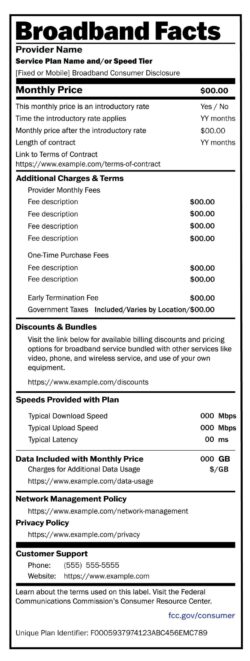
I'm not particularly familiar with the topic as I haven't looked at new broadband plans in the past few years*, but I stumbled on some blurbs about an FCC vote that supposedly tests the waters for simplifying the "nutrition labels" currently required for broadband and mobile plans. I haven't been able to find a lot of information on the recent discussion and vote. One article mentioned that the requirement is not always being adhered to currently, and that generally speaking, ISPs were against the requirement being implemented.
The image attached is a sample of the information required on the label you would see when purchasing or comparing broadband plans. Note that in addition to itemized fees, typical up and down speeds, and latency are included. I don't believe latency was a required data point when I last purchased a broadband package. I'll link the FCC pages and some articles below.
*one of the articles mentioned that xfinity (that is our carrier) does show the appropriate info for new plans, but not consistently when comparing plans for changing your service; we recently changed our plan tier, and I do not believe this label had been displayed.
I did try to keep the above as impartial as I could. My opinion on the topic though is that mobile and broadband carriers are both as shady as they are allowed to be. They may argue that transparency regulation is wasteful, but you can rest assured that they have the information down to the penny, Mbps and ms already, and displaying it on a computer screen for you to compare is not costing them anything tangible.
I've seen some other opinions that the goal may be to undermine the usefulness of the label by watering it down, and then eventually being able to say "it's not helping anyone, so we may as well eliminate it entirely."
I'm not a religious person, but I do try to respect the beliefs of those around me, and I don't ever want to diminish someone else's faith.
But when I see someone that flouts their religion, cites virtues, and attacks others in ways contrary to their supposed beliefs, I see an inexcusable hypocrisy.
And I don't believe that a lack of faith, or belief in an afterlife means that there is no reason to be a good person. I believe that gives us a greater responsibility to make the world a better place - both for those with us now, and for those that follow us.
I originally posted the above on Instagram where I was limited for space if I wanted to keep it to one slide. I said above that I'm not religious, but I still have a lot of respect for those that sincerely dedicate their lives to guiding and bettering humankind. What initially prompted me last night was seeing that at least a second pastor had been peppered by ice.
Children have been zip-tied, and now I'm seeing that children were tear-gassed on their way to a Halloween party this past weekend. If that's "collateral damage", that doesn't make it any less horrifying.
How can anyone justify this behavior? The fact it is happening, and thus far without any meaningful consequences is appalling, and a stain on this country. And now in addition to people being scared of leaving their homes, many are afraid of not being able to eat or worse, not being able to feed their children.
I'm as angry as I've ever been, and I feel useless. I like to think that I don't hate frivolously, so when I do say I hate, I truly mean it. I may not believe in a hell, but there are some people for whom I won't be disappointed if there is one. And no, a presidential pardon or Nobel peace prize wouldn't let you buy your way out of that trip.
I've tried to be more vocal and socially active a few times in my life. I've found that I can do it for a couple days and then I'm ready to hide in the dark somewhere for the rest of the month. My reset is the 30th, so march can be rough if I try to be social in early february...
Since I'm getting a cramp in my angry-scrolling-and-clicking-finger, I thought I'd share some options for anyone that might interested in ditching or minimizing use of their social media accounts with the companies like facebook and twitter.
I will add the caveat that I have left various social media platforms over the years, and facebook has been the hardest one to kick permanently because its is the only singular overlap for many of the people that I know. It's one of those situations where it's gotten so big that most people don't consider going to anything else. So, when I've made the jump to other social media, I didn't know anyone using those platforms.
Currently I have accounts on facebook, instagram, bluesky, dice.camp (mastodon), and I guess I can throw linkedin and discord in there. I'm not going to delete my facebook account again at this time, but it is one that I would jump off in a heartbeat if there were viable alternatives where the people I know were.
*note that I am not familiar with upscrolled, having just learned about it today. I heard it was a good alternative to instagram, but I can't verify that yet.
I'm kind of hesitant to include this one because they have been very in-your-face with paid features lately, but discord will let you create "private servers" and you can control who you let in. I have a private server that I use for gaming, and I've stayed active with a couple different friend-groups across a couple other servers.
If you've got other social media or digital platform alternatives that you're using, I'd be interested in learning about them. I mostly listen to music that I self host from my CD collection rips, but youtube is another thing I haven't found a good alternative for yet. If you pay for spotify premium and are looking for an alternative, I've heard that qobuz is a decent choice that pays artists more per listen.
I ditched pinterest a while back because it was turning into nothing but ads and AI-content. I haven't found an alternative I'm completely happy with yet, but I've been using obsidian.md for a lot of the things I was doing with pinterest. obsidian is primarily a text editor, but it can handle images, and you can do some amazing things with plugins and a little CSS. Obsidian is free to use, and because at its heart it is a text editor, if the program ever stops being supported, your files are still accessible as plain text.
Technology is what I know and follow, so that's what I have to share. If you've got alternatives to mega-corporataions like amazon, or environmentally-friendly choices like powdered soap vs. liquid detergents that you use, I'd love to hear them.
This is kind of an uncharacteristically personal note. I'm going to try to write this straight through and not keep editing it over and over like I normally do. I'm not sure if that will keep it it more authentically representative of my own voice or not. I don't know what my purpose is writing this. It's not about current events, and I don't mean to distract from anything going on right now. Some of it has been in my head for a few days and just needed an outlet, I guess.
I've got music playing on random so I don't have a playlist influencing a specific mood, just personal and current events. Nolan's off from school today and Lynda and I have been alternating playing with him throughout the day. We've had workers outside digging up our yard installing fiber optic lines, been impatiently waiting for that since moving here. I'm happy it's finally getting done, but the noise has not been great for this near-endless headache. Otherwise though, the day has been pretty good. I've had noise-canceling headphones on to counter the noise outside.
A little while back Miles had his annual vet appointment and he had a growth examined, it turned out to be a cancerous sweat gland. The vet was able to remove all of it, but we'll have to keep an eye on him for the rest of his life, and we had a couple weeks of waiting for lab results to confirm if it was cancerous. After losing Duncan to cancer I know that every time I find a knot or something stuck to his fur I'm going to have a moment of panic.
I'm on a short-term leave again, this time because of the side effects from the medications I started on for the headaches. I'm still getting headaches just about every day, but they're mostly milder, and they're at least not constant throughout the day. I'm up to 18 doses of various medications that I take during the day, plus another six that are taken as-needed. Several of those cause eye-dryness, causing double vision and blurriness, and I get dizziness and drowsiness issues from a few. I just got cleared to go back though, so I should be working again in a week or two.
A few months ago I started having a weird bee-sting sort of sensation in my right quadricep whenever I walk fast or stretch my leg. Now it's happening elsewhere too and that's been pretty limiting. Being physically limited really makes me beat myself up. I tie up a lot of my self-worth in what I can do physically. I realize it doesn't matter at all, and no one else cares how much I can lift, but I am furious at myself that I can't bench x, squat y, deadlift z, etc., even knowing how long it has been since I've done any of those.
I think of myself as reasonably smart, but weirdly, I don't think I tie as much of my own self-valuation to that. That may not have been as true when I was younger. Now though, it makes me more self-conscious and I tear myself down over it. I'm constantly worried that I think I'm better than I am -- that maybe I think I'm smarter than I am, more capable than I am, or that I care about causes or people out of feelings of obligation rather than altruism.
At the same time, I look back and feel a sense that I had a responsibility to do better with whatever potential I may have had, but that I have wasted that opportunity. I don't think I ever knew what I expected to do with my life, but I know at some point in my mind, success to me meant doing something that bettered the world. I guess that's a pretty tall order, but I felt like that was at least part of my life's goal. I can sincerely say all the right things about how I'm happy with where I am right now with my family and job, but I can't say that I don't feel a sense of having failed at life.
I could ramble on, but if you've gotten this far, I've already taken up enough of your time. And if I were to go on, I'd probably want to start editing, or maybe finding a purpose to having written this, in which case it would probably turn into something wholly different, which might not be a bad thing, but I don't know.
I was the owner of the land (and I can use it) I was the one that future planned (and I can use it) I was the one that for years dwelled (and I can use it) I was the one fee simple held (and I can use it) I still live here but I'm old I have an interest I still hold I grant to you but still obstruct My interest usufruct
I convey with language unclear (and I can use it) I am the one still living here (and I can use it) I am grantor and I decree (and I can use it) I hold in perpetuity (and I can use it) I still live here but I'm old I have an interest I still hold I grant to you but still obstruct My interest usufruct
I hereby grant this to you (I hold an interest) I hereby grant this to you (I hold an interest) I hereby grant this to you (I hold an interest) I hereby grant this to you (I hold an interest) I hereby grant this to you (I hold an interest) I hereby grant this to you (I hold an interest) I hereby grant this to you (I hold an interest)
I am the signer on the line I left some printed verbiage fine I will henceforth, therefore, whereby I get to live here till I die I transfer but I'm not done (and I can use it) I gift to my daughter or to my son (and I can use it) I will to you bequeath (and I can use it) But not till I'm six beneath (and I can use it) I still live here but I'm old I have an interest I still hold I grant to you but still obstruct My interest usufruct I still live here but I'm old I have an interest I still hold I grant to you but still obstruct My interest usufruct
Three years today, and still think about him often. My mind has latched onto the loss and the guilt more than it has the good memories, making it hard to think about him without sadness. Miss you, buddy.


 Loud. Proud. Ginger.
 LGBTQ+ | Progress over performative
 Unfiltered truth in Reels & Real life